
It sounds simple when you purchase gold bars: you can choose the purist one. However is 24K always the most profitable to your investment? Gold bars appear shiny but they are not exactly the same and their purity levels influence the value of gold bars, their marketability, and their storage.
Understanding the difference between 24K and other purities, like 22K, is crucial. It’s the difference between a bar that’s ideal for deep storage and one that might be more practical for certain markets. Let’s break down what you need to know to make an informed purchase.
Gold Karats Explained: Finding the Right Purity for You
The best thing to do depends on having a balance on the purity of the gold and the practicality of the gold. Every piece of gold is marked with the karat (K) to indicate its purity.
How the Karat Scale Actually Works
Forget complex chemistry. The karat system is straightforward: pure gold is 24K. This means any lower karat is simply a ratio of pure gold to stronger alloy metals.
- 24K Gold: 99.9% pure gold. Too soft for most jewellery.
- 18K Gold: 75% pure gold. It combines luxury and longevity.
- 14K Gold: 58.3% pure gold. It is the most popular option since it is powerful and is also valuable.
- 10K Gold: 41.7% pure gold. It is the most difficult and the lowest cost option.
10K vs. 14K vs. 18K vs. 24K Gold
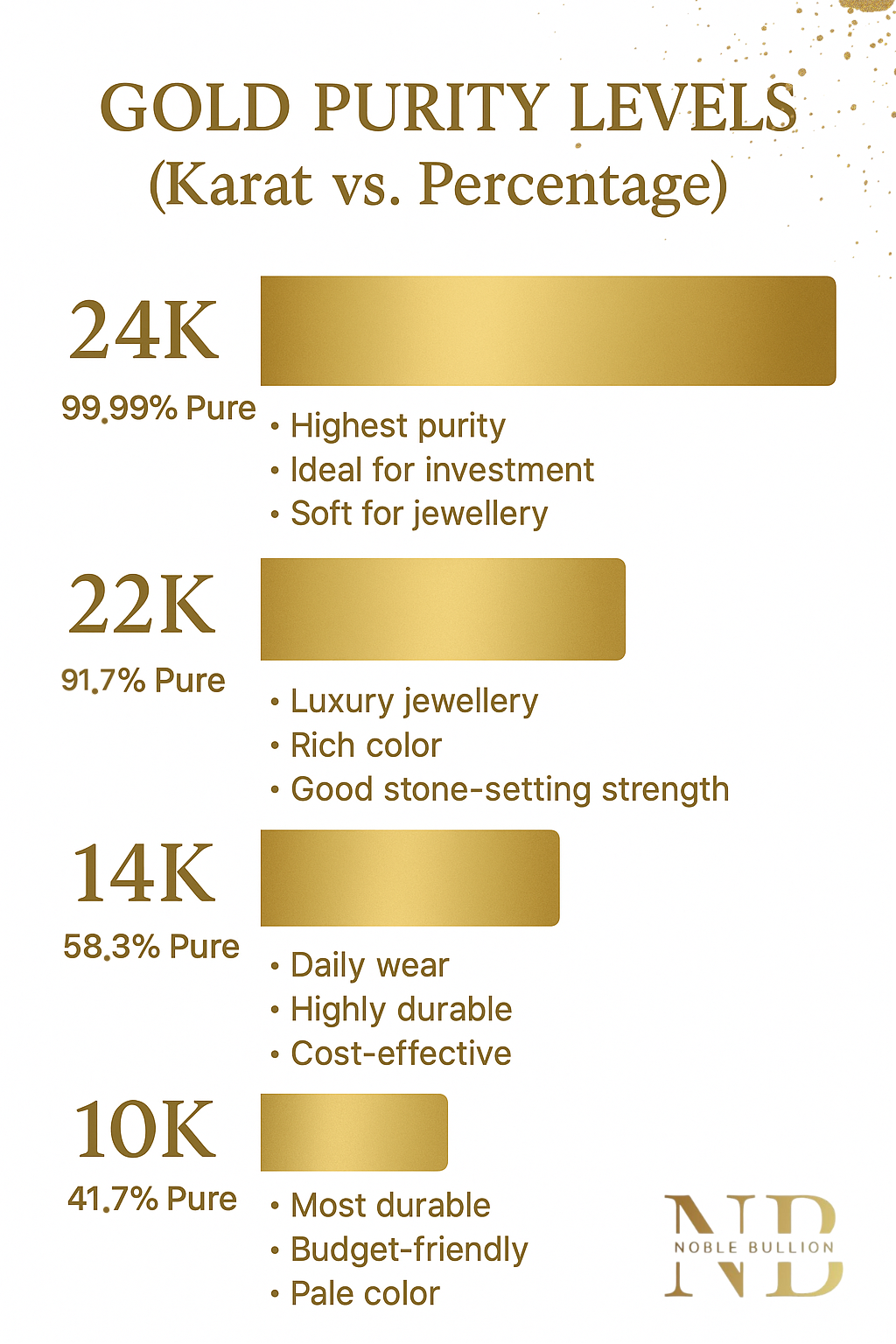
A decision on karat implies a sacrifice of purity, hardness, and cost of the karat. 24K is soft and is difficult to work in fine jewelry, and is very pure. The chart below shows how the most popular karats will perform as an investment.
22K Gold (91.7% Pure)
This gold is of high purity, and it appears almost the same as 24K, only stronger due to the small quantity of alloy. It is effective with simple designs such as plain wedding bands.
- Best for: Jewelry in simple forms and that which lacks gems.
- Consider: It’s still too soft for secure prong settings.
18K Gold (75% Pure)
The benchmark for luxury jewelry, 18K boasts a deep golden hue and excellent purity. It’s a top choice for high-end watches and signature pieces.
- Best for: Heirloom-quality pieces and those with metal sensitivities.
- Consider: Its softer nature means it will develop a patina of scratches over time.
14K Gold (58.3% Pure)
The most popular choice for engagement rings, 14K gold masterfully balances gold content with everyday resilience. It offers a classic color and is significantly more scratch-resistant than 18K.
- Best for: Everyday wear, especially for active lifestyles.
- Consider: The higher alloy content may cause irritation for those with nickel allergies.
10K Gold (41.7% Pure)
As the most durable and affordable legal gold, 10K is built to last. It has a pale color due to its low gold content.
- Best for: Budget-conscious buyers and jewelry worn in rough conditions.
- Consider: Its pale color and high alloy mix make it the most likely to cause skin reactions.
How to Choose Your Gold
It is up to you and what you want to achieve. Do you purchase something to wear on a daily basis or do you purchase with a specific intention of increasing your wealth? Whenever you possess your purpose, then the right choice becomes evident.
Which gold is best for jewellery?
If you’re purchasing for wearability, your lifestyle dictates the karat.
Choose 14K Gold for:
- Engagement rings and bracelets.
- A powerful ring that is capable of withstanding everyday use.
- Traditional appearance combining the amount of gold and its strength.
Choose 18K Gold for:
- Luxury statement pieces and high-end watches.
- A richer color and superior purity for special occasions.
- Those with sensitive skin, as its higher gold content is hypoallergenic.
A Note on Tradition:
Most cultures use 22K as an indicator of wedding jewelry. It is bright and easy to resell, which suits the category of heirlooms and special ceremonial items.
Which gold is best to buy?
The purity of wealth when you accumulate it is most important. 24K gold is the most serious option of wealth accumulation. It is the coin standard, bar, and bullion standard since its value is determined by the quantity of gold within it that is easily marketable.
Modern platforms have simplified this process, allowing you to buy and sell certified 24K digital gold with full transparency and security.
Match the gold to its purpose. In the case of jewelry to wear them, 14K or 18K are the best as they are strong. In the preservation of pure wealth, there is no better thing than 24K.
Conclusion
Understanding the difference between 18k and 22k gold is crucial, but for a pure investment, the question of which gold is best has a clear answer: 24K. While other purities have their place in jewellery, your portfolio deserves the undisputed standard for wealth preservation.
We are currently trading in 24K investment-grade gold coins and gold bars at Noble Bullion. It is easy to shop with us because we provide:
Assured Purity: Every bar is certified 99.99% pure gold.
Optimal Liquidity: Your assets remain highly liquid and recognized worldwide.
Secure Storage Solutions: We provide fully insured, professional vaulting options.
You now have the knowledge. Let us provide you with the asset.
Ready to invest with confidence? Explore our curated selection of 24K gold bars today and build your legacy with Noble Bullion.
FAQs
What does the “Karat” value actually mean?
Karat (K) is used to measure the amount of gold in a piece of 24 parts where 24K represents all gold and 18K represents 18 parts of gold and 6 parts of other metals which is 75% of the gold. The larger the karat the more is the amount of gold.
How does purity impact gold’s durability?
Gold in its pure state is softer and easily scratched. Gold of lower karat (such as 10K or 14K) is tougher to use on a daily basis due to the additional alloy metals.
Why isn’t 24K gold used for most jewellery?
The 24K is too soft to use as everyday rings or bracelets. It becomes soft easily and scratches when used on a regular basis. It is ideal with investment bullion.
What makes 18K gold so popular for fine jewellery?
18K is a good combination: 75% gold provides a rich color and value and 25% alloy provides adequate strength to set the stones and elaborate designs.
Which karat offers the best value?
To most individuals, 14K or 18K would be a good balance between durability, purity, and cost. 14K would be used on day to day gift, and 18K in luxury and treasured items.